Home › History › The Printer's Apprentice
The Printer's Apprentice
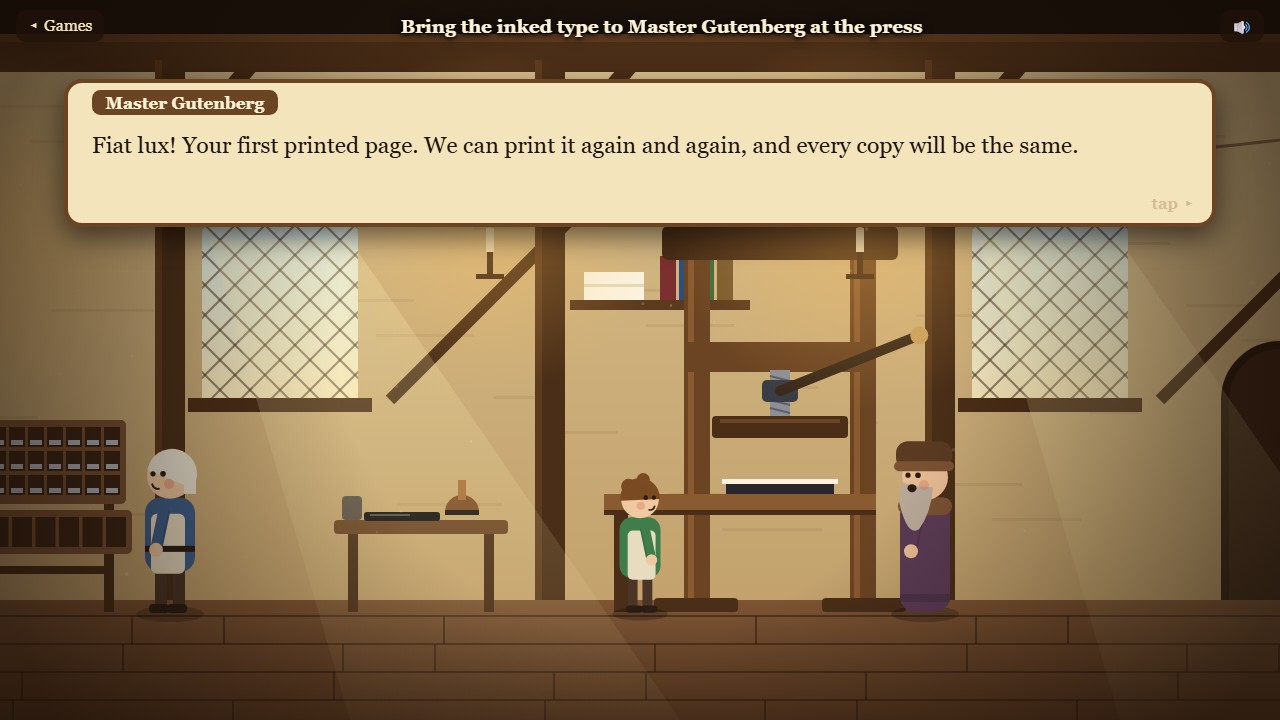
Mainz, 1450. You are the new apprentice in Gutenberg's workshop: set the type, ink it and pull the press.
Open The Printer's Apprentice full screenProgress is saved in this browser only.
What it is
You are twelve, and it is your first day as an apprentice in Johannes Gutenberg's workshop in Mainz in 1450. Walk through the workshop and do each job by hand. Copy a line with a quill, the way a scribe does. Set metal type, which is a mirror image and so goes in backwards. Ink it. Then work the press one step at a time: lay the paper, roll the bed under, pull the bar, peel off the page. After that you race the scribe, printing whole pages while he writes a single line. The man who lent Gutenberg the money then walks in and asks what the workshop should print, and the game tells you what really happened. It ends with five events to put in order and a page of facts that says which people were real and which were made up for the story.
What you practise
- What books were before printing: copied by hand, slow and costly
- How a press with movable metal type works, one step at a time
- Why type is set as a mirror image
- Cause and effect: cheaper books, more people reading, ideas travelling faster
- Putting events in order, from hand-copied books to presses in hundreds of towns
- Printing was not brand new: movable type in China around 1040, metal type in Korea in 1377
- Telling the real people and events from the made-up parts of a history story
How to play
Walk with the arrow keys, or tap where you want to go. A gold arrow marks the next person to talk to; press the button, Space or Enter when you reach them, and tap or press Space to move the talk along. Each job says what to do: hold to write, tap the metal letters, rub the ink ball over the type, hold and let go to pull the bar. A wrong try costs nothing; you do it again. The speaker button turns the sound off.
For teachers and parents
- Most players set LUX in reading order first, and it prints XUL. Ask why before the second try.
- The last screen gives the seconds one hand-copied line took and the pages printed in 20 seconds. Which is faster, and by how much?
- The scribe asks what will become of scribes like him. What would the class tell him? Is there a machine like that today?
- The question about what to print has no wrong answer. Have players defend their choice, then compare it with what Gutenberg did.
- The stars come from the order check at the end: three for getting it right the first time.
- The last screen says who was real and who was made up. Why should a history game say so?
More like this